Which AI Writing Tool Will Serve Your Needs Better: Rankforge AI vs Rytr?
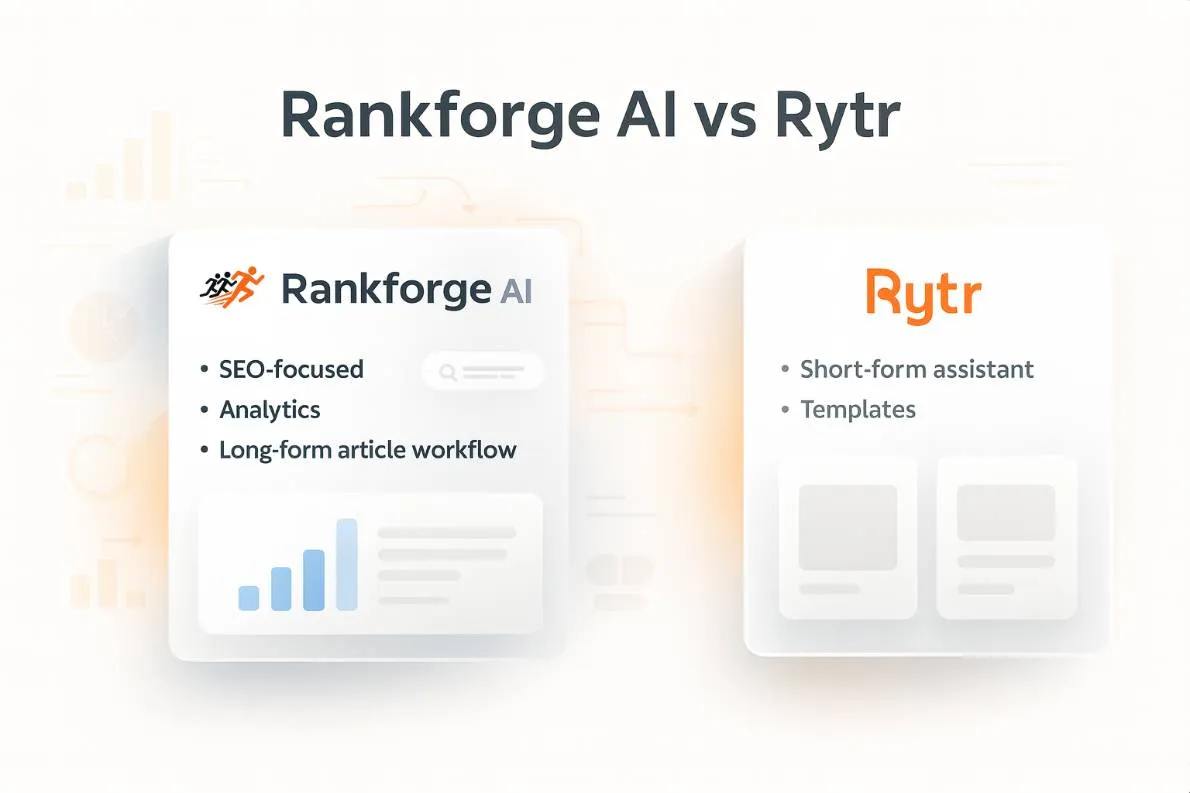
Choosing between Rankforge AI and Rytr comes down to what you expect from an AI writing platform:
Do you need an SEO engine that can generate long-form articles, optimize them for Google and AI-powered search, and plug into your analytics?
Or do you need a versatile writing assistant that can quickly spin up emails, captions, blog sections, and other short-form pieces?
Rytr is built as a general-purpose AI writing assistant. It helps you generate many types of content quickly and affordably, with dozens of templates and tone options.
Rankforge AI, on the other hand, is an enterprise SEO content platform from 247 Workforce. It focuses on generating long-form, search-optimized articles in about 10–15 minutes, with built-in search and AI-visibility optimization, website audits, and schema markup.
This comparison will help you decide which one better fits your content workflow.
Rankforge AI vs Rytr: Quick Snapshot
Choose Rankforge AI if you:
Want a search-led content engine, not just a writing assistant
Need 2,000+ word SEO articles generated in 10–15 minutes, ready to publish or lightly edit
Care about ranking on Google and appearing in AI-driven search experiences and overviews
Want integrated website audits, using your search data to find content gaps and declining pages
Choose Rytr if you:
Need fast, multi-format content: emails, blog sections, captions, ads, replies, and more
Prefer a simple, low-friction writing assistant with plenty of templates and tones
Want a freemium model and low-cost paid tiers for ongoing usage
Rankforge AI Overview
What Rankforge AI Does
Rankforge AI is an enterprise-grade SEO content platform built by 247 Workforce. It’s designed to help teams:
Generate long-form, SEO-optimized articles (typically 2,000+ words) in about 10–15 minutes
Optimize content simultaneously for Google search and AI-powered assistants / overviews, so your content can be cited and surfaced across major AI platforms
Reduce content creation costs compared with traditional agencies or purely manual workflows
It’s positioned for content teams that care about search rankings, AI visibility, and analytics, not just “getting words on the page.”
Key Features of Rankforge AI
From the official site, core capabilities include:
AI-Powered Long-Form Writing
Generates comprehensive, human-readable articles in the 2,000+ word range.
The workflow explicitly includes research, writing, SEO polishing, grammar checks, and schema generation.
SEO & LLM Optimization
Articles are optimized for Google search and also tuned for AI platform visibility, so they have a better chance to show up in AI overviews and answers.
Structured data (JSON-LD) is part of the output, helping articles win rich results.
Website SEO Audit (Free Tool)
Integrates with Google Search Console to run a detailed SEO audit.
Surfaces pages losing traffic, declining keywords, low-CTR opportunities, content refresh needs, and technical SEO issues.
Lets you download a full report so you can prioritize fixes and new content.
Workflow & Delivery Options
Articles can be downloaded as DOCX or Markdown.
Delivery hooks include sending content via email or into your team communication channels for review and publishing.
Pricing and Plans (Rankforge AI)
Rankforge AI currently offers a limited free experience (1 free article), after which you can pick from three tiers:
Starter – $35/month
Around 15 articles per month
10–15 minute article generation
SEO + AI platform optimization
Up to 2 website audits per month
DOCX export and standard support
Professional – $70/month
40 articles per month
All Starter features, plus keyword research and content calendar generation
Up to 4 website audits per month
Priority support & onboarding
Enterprise – Custom pricing
100 articles per month
All Professional features
Up to 8 website audits per month
Support for multiple websites and enterprise-grade onboarding
The cost per optimized article is significantly lower than typical agency rates, especially once you factor in included schema and audit capabilities.
Rytr Overview
What Rytr Does Well
Rytr is a general-purpose AI writing assistant focused on fast, flexible content creation. According to its official site, Rytr:
Supports 40+ content use cases and templates (emails, meta titles, blog outlines, paragraphs, ads, responses, and more)
Works in 20–40+ languages, with 20+ tones and custom tone of voice options
Helps with everything from short-form snippets (captions, CTAs, comments) to longer sections of blog posts and landing pages
Includes a plagiarism checker, browser extension, and the ability to create custom tones so content sounds more like you
In short: Rytr is a Swiss Army knife for content creators who want one tool for lots of writing formats.
Pricing and Plans
Rytr uses a freemium model with three main tiers:
Free – $0/month
10k characters per month
Access to 40+ use cases and one language
Access to the browser extension
Unlimited – advertised from $7.50/month on the official site (with annual billing), or around $9/month on some pricing aggregators
Unlimited content generation
1 custom tone of voice
Monthly plagiarism checks
Premium – around $24.16–$29/month, depending on billing and source
Increased input limits
Multiple custom tones
More languages and extra plagiarism checks
Rytr reports a 4.9/5 overall satisfaction score across platforms like Capterra and G2 on its homepage, while its G2 profile specifically shows about 4.7/5 from 800+ reviews.
What Users Commonly Point Out
From public reviews and the product site:
Positives
Very fast at producing usable drafts
Wide variety of templates for marketers, freelancers, and small businesses
Strong value for money compared with many AI tools
Limitations
Best for short-form content and smaller chunks of long-form work, not full SEO-driven content strategies by itself
Some reviewers feel higher tiers can be pricey for their specific needs
You still need human editing for nuance, brand voice, and depth—like with any AI tool
Rankforge AI vs Rytr: Key Differences
1. Primary Use Case
Rankforge AI is built for SEO-first, analytics-driven content operations. Its focus is long-form articles that rank on Google and appear in AI search experiences, supported by audits and structured data.
Rytr is built for everyday content tasks: emails, captions, ads, blog sections, and other short- to medium-length pieces across many use cases.
If your content operation lives and dies by search performance, Rankforge AI is more aligned. If you just need “write this quickly in a decent voice,” Rytr is usually enough.
2. Depth of SEO & Analytics
Rankforge AI
Connects with your search console data to analyze keywords, traffic trends, click-through rates, and pages that need updates.
Generates audit reports that highlight content gaps and technical issues, then uses this to guide what you should create or refresh.
Rytr
Offers SEO-oriented templates (e.g., meta title/description generators, keyword extractors) but does not function as a full SEO analytics suite.
You’ll generally rely on separate SEO tools or your analytics stack to decide what content to create and how it’s performing.
If you want insights + content in one place, Rankforge AI has the edge. If analytics already live in another tool and you just need a writer, Rytr is simpler.
3. Content Format & Output
Rankforge AI
Specializes in long-form, 2,000+ word articles with SEO structure, headings, meta tags, and schema.
Optimized not only for organic search but also for AI overviews and assistants, so your content can be cited as a trusted answer.
Rytr
Excels at shorter formats (paragraphs, emails, captions, ads), and also supports multi-section blog content.
Less opinionated about SEO structure; it can help, but you’ll usually define the strategy and structure manually.
For SEO pillar pages, programmatic content, and long-form authority pieces, Rankforge AI is purpose-built. For day-to-day messaging and marketing copy, Rytr is more flexible.
4. Speed & Workflow
Rankforge AI:
Targets 10–15 minute generation windows for full, ready-to-edit articles, including schema and SEO polishing.
Rytr:
Generates content almost instantly for each prompt—ideal for quick responses, idea generation, and short-form copy.
Both are “fast,” but Rankforge’s speed is about complete articles, whereas Rytr’s speed is about rapid iterations on smaller units of content.
5. Pricing & Scaling
Rankforge AI is structured around articles per month + audits—great if you know how many long-form pieces you’ll publish monthly and need predictable, SEO-optimized output at a lower per-article cost than agencies.
Rytr is organized around characters per month / unlimited generation at low price points, ideal for freelancers, creators, and small teams who need lots of smaller content pieces.
If your team’s bottleneck is SEO articles and rankings, Rankforge’s pricing structure will feel natural. If it’s general writing volume, Rytr’s tiers are very attractive.
Common Mistakes to Avoid
Expecting AI to replace human editors
Both Rankforge AI and Rytr can dramatically reduce drafting time and help with idea generation, but neither should be treated as a full replacement for editorial review.
Plan for human editing to refine voice, verify facts, and align with your brand.
Choosing without a clear use case
If your biggest challenge is SEO performance, AI visibility, and content measurement, Rankforge AI is better aligned.
If your main need is fast, multi-format writing support across everyday tasks, Rytr is more appropriate.
Ignoring your existing tooling
If you already have a heavy SEO stack, you might use Rytr just for drafting.
If you don’t have strong SEO analytics today, Rankforge AI’s audit and reporting capabilities can become the backbone of your search strategy.
How to Choose the Best AI Writing Tool for Your Needs
Use this checklist to test Rankforge AI and Rytr against your real workflow.
1. Features vs Use Case
Need SEO-driven long-form content, audits, and AI search visibility?
→ Shortlist Rankforge AI.Need general writing help across emails, posts, blog sections, and quick marketing content?
→ Shortlist Rytr.
2. Ease of Use & Time-to-First-Draft
Rytr shines if you want to sit down, type a prompt, and get usable content in seconds with minimal setup.
Rankforge AI is still simple but expects you to think in terms of SEO strategy—keywords, audit insights, and long-form outlines.
Ask yourself: Which one gets me to a publishable draft, for my specific use case, with the least friction?
3. Pricing Fit
If you publish several SEO articles per month and want them all optimized for Google and AI platforms, Rankforge AI’s per-article economics can work out very favorably compared with agency or freelance rates.
If you’re focused on many smaller pieces (emails, captions, ads), Rytr’s free and low-cost plans are ideal.
4. Output Quality (for your niche)
Run live tests:
Feed each tool the same brief.
Compare the drafts on structure, depth, tone, and how much editing they need.
For SEO content, check how clearly Rankforge AI uses headings, internal logic, and search-friendly structure.
For general writing, check how well Rytr adapts tone and keeps your style consistent.
Practical Tips
Always trial before committing
With one free article from Rankforge AI and a generous free plan from Rytr, you can test them in your real pipeline before paying.
Define “success” upfront
For Rankforge AI, success might be higher rankings, better AI visibility, and audits that clearly inform your roadmap.
For Rytr, success might be saving hours per week on routine writing tasks.
Keep humans in the loop
Use AI to automate research, drafting, and formatting, then rely on your editorial judgment for nuance and originality.
FAQs
1. Is Rankforge AI a direct alternative to Rytr?
Not exactly. Rankforge AI is a specialized SEO content and audit platform focused on long-form, search-optimized articles and AI search visibility. Rytr is a general AI writing assistant built for a wide range of short- and mid-length content formats.
2. Can I use both Rankforge AI and Rytr together?
Yes. A common setup is:
Use Rankforge AI to plan and generate your SEO pillar content and long-form articles.
Use Rytr to handle ancillary content like emails, social posts, and quick copy derived from those pillar pieces.
3. Which tool is better for ranking on Google and appearing in AI overviews?
Rankforge AI is explicitly designed for that outcome. It combines SEO optimization, schema, and audit data to help you rank on Google and improve your chances of being surfaced in AI-powered search experiences.
Rytr can assist with writing, but it doesn’t manage search analytics or AI-visibility tracking end-to-end.
4. Which is more budget-friendly for a solo creator?
If you mostly need general writing help, Rytr’s free and low-cost plans will usually be the most budget-friendly. If your primary bottleneck is high-quality SEO articles and you’re already spending on writers or agencies, Rankforge AI’s per-article cost can quickly become competitive or cheaper.