Which Strategy Will You Choose: PPC vs SEO for Sustainable Growth?
You have likely wrestled with PPC vs SEO more than once. One promises instant visibility; the other builds durable momentum. The smartest path is not choosing one forever, but knowing when each fits your goals—and how to make them reinforce each other so you are not overpaying for clicks or waiting months without results. This guide breaks down the fundamentals, key differences, practical trade-offs, and a playbook for using both channels together—plus how AI and attribution are changing the PPC vs SEO decision.
Defining PPC and SEO: The Fundamentals
Pay-per-click (PPC) is an internet marketing technique where you pay each time a qualifying click occurs on your ad. You can bid on keywords, place ads on Google, Bing, and Yahoo, and gain immediate visibility at the top or bottom of search results. It is the quickest method for listing on top pages and can target audiences by country, region, or city—ideal when you need results fast.
Search engine optimisation (SEO) is the process of improving your website so it ranks higher in organic results. It focuses on helping search engines understand each page and how it serves users, using strategies such as relevant keywords, title tags, image tags, and clean HTML. In contrast, SEO drives free, organic traffic and compounds over time, but one should expect a longer runway for results.
In short: SEO steadily improves organic visibility. PPC provides speed and control. PPC vs SEO is not a battle—each serves a distinct purpose in your growth plan. Avoid common pitfalls in both: for SEO, do not stuff keywords or neglect user experience; for PPC, manage your budget and monitor performance to avoid overspending without returns. Use PPC for immediate results (promotions, launches), and SEO for sustainable growth.
Key Differences Between PPC and SEO
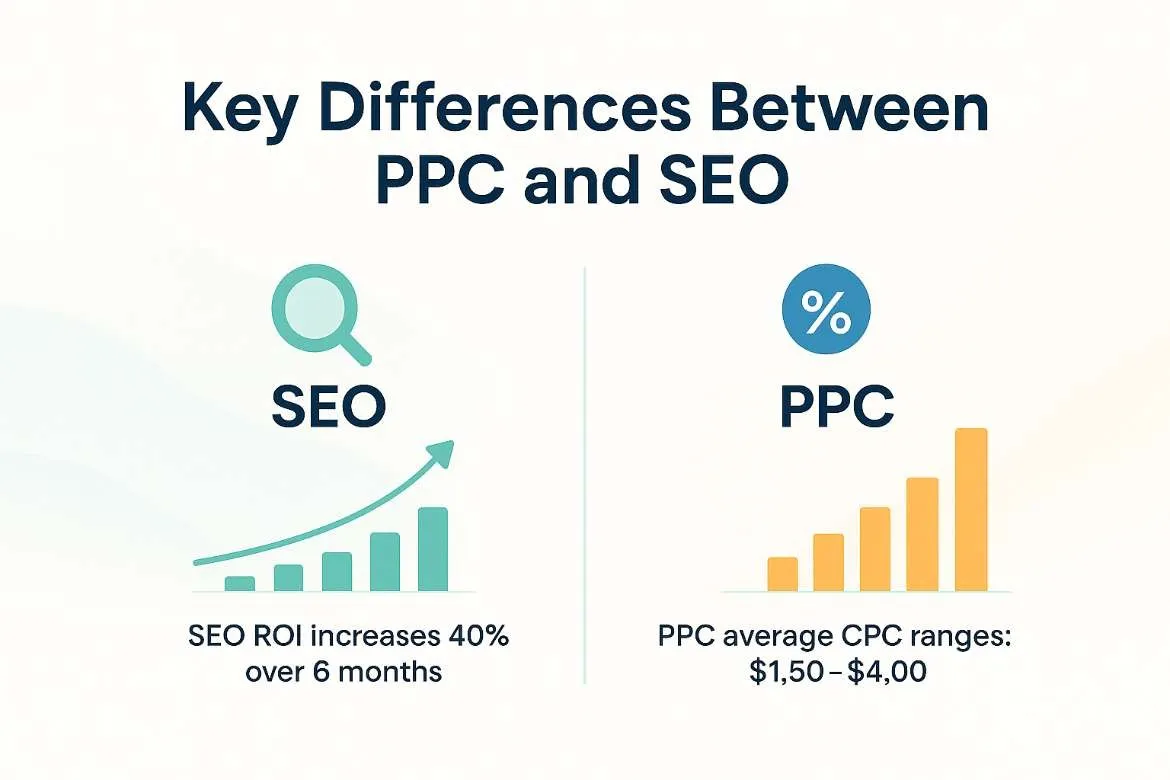
When you are weighing PPC vs SEO, a few distinctions will guide your choice:
- Cost and ROI profile
- SEO is a long-term investment with gradual ROI.
- PPC incurs immediate costs and can deliver quicker returns—but only while you are funding it.
- Visibility
- SEO results appear among organic listings.
- PPC ads appear at the top or bottom of results pages for immediate visibility.
- Traffic source
- SEO attracts organic traffic from users actively searching for relevant content.
- PPC drives paid traffic via ad clicks.
- Time to results
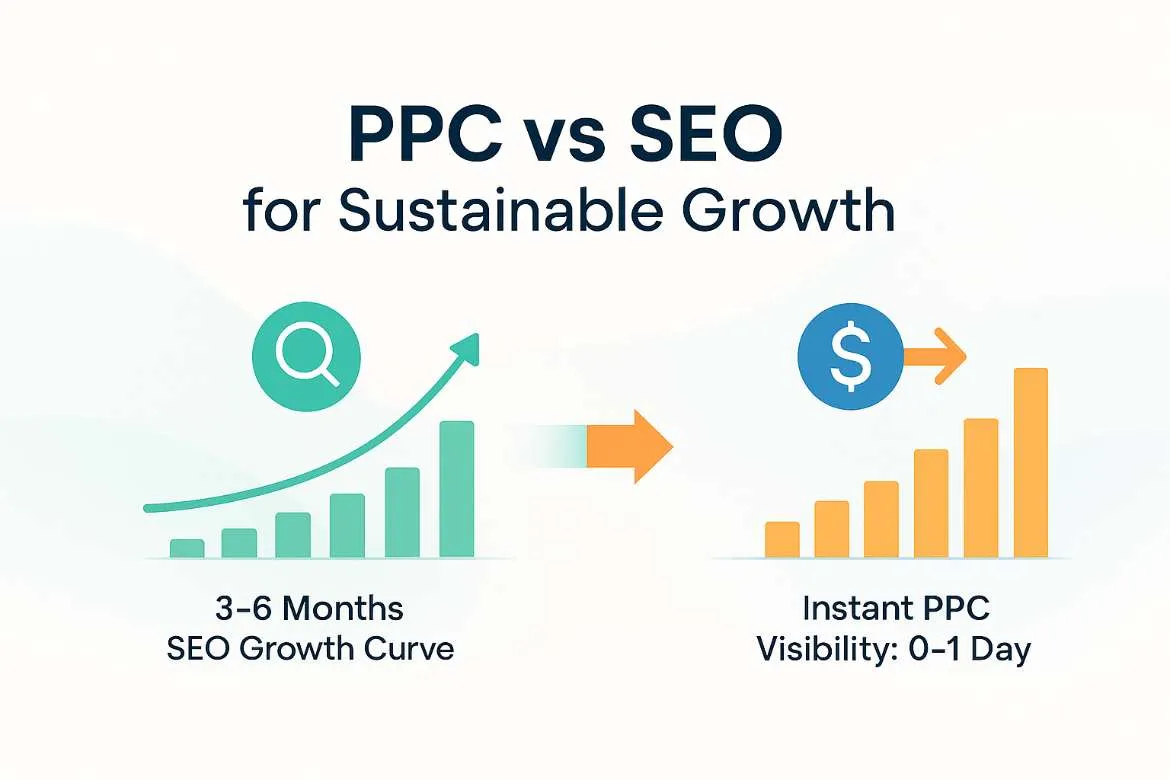
- SEO often takes weeks to months (commonly 3–6 months) to show significant gains.
- PPC delivers results as soon as campaigns go live.
- Sustainability
- SEO momentum can be long-lasting with ongoing adjustments.
- PPC stops the moment the budget is exhausted.
- Control and targeting
- PPC offers granular control over keywords, creative, and audience targeting.
- SEO relies on ranking factors you influence but do not fully control.
Practical takeaways for PPC vs SEO:
- Use SEO to build brand credibility and long-term traffic.
- Use PPC for immediate sales, time-sensitive campaigns, and precise targeting.
- Avoid the trap of selecting only one by default; a combined programme often performs best.
Pros and Cons of PPC and SEO
Understanding the trade-offs helps you avoid misaligned expectations with PPC vs SEO.
Pros of SEO
- Cost-effectiveness in the long term: Organic traffic can compound, reducing acquisition costs over time.
- Long-term ROI: Gains can persist with steady maintenance.
- Wide reach: Strong content can rank for many relevant searches.
- Trust and credibility: Users often prefer organic results.
- Qualified intent: Captures users actively searching for what you offer.
- Lower maintenance once established: Requires less ongoing spend than PPC.
Cons of SEO
- Slow ramp: Results can take weeks to months.
- Broad skill set needed: Content, keywords, and technical optimisation must work together.
- Competitive battleground: Popular keywords are crowded.
- Algorithm updates: Shifts can impact rankings and demand adjustments.
- Measuring ROI can be complex: Multi-touch journeys make attribution tricky.
Pros of PPC
- Speed: Traffic and visibility as soon as campaigns are live.
- Precise targeting: Demographics, location, interests, and keywords.
- Guaranteed placement: Ad slots at the top or bottom of SERPs.
Cons of PPC
- Expense: Costs climb quickly, especially for competitive terms.
- Profit not guaranteed: High click costs do not ensure conversions.
- Temporary visibility: Traffic stops when spend stops.
Avoid these mistakes in PPC vs SEO:
- SEO: Keyword stuffing and poor user experience.
- PPC: Targeting overly broad keywords and failing to monitor performance.
Strategic Choice: When to Use PPC vs SEO
The right choice between PPC and SEO depends on your goals, timeline, and budget.
- If you need fast sales or immediate visibility: PPC is the better fit.
- If you want sustainable, compounding traffic: SEO is the better fit.
- For most businesses, PPC vs SEO is not either/or. It is both—sequenced and budgeted for your objectives.
Scenario guidance:
- New product launch: Use PPC for instant visibility and early traction.
- Rebrand: Use both—PPC to control messaging during the transition, SEO to rebuild and grow organic visibility.
- Lead generation: Invest in SEO for nurturing and long-term ROI; layer PPC to accelerate the pipeline where needed.
Common missteps:
- Over-valuing PPC’s immediate lift while ignoring SEO’s compounding benefits.
- Not aligning channel choice to clear objectives and timelines.
- Expecting SEO-level sustainability from PPC or PPC-level speed from SEO.
Remember: SEO often needs 3–6 months to move the needle, while PPC switches on immediately. In PPC vs SEO planning, match the channel’s strengths to your goals before you allocate budget.
Optimising Both Strategies: A Synergistic Approach
SEO and PPC work best as complementary systems. Treat them as one performance engine with shared accountability, and you will unlock gains neither achieves alone.
- Conversions and pace
- Both improve conversions; PPC tends to yield quicker results, while strong SEO can produce higher conversion rates over time.
- Stabilise during volatility
- Use PPC to maintain traffic during SEO penalties or core updates. When organic rankings fluctuate, PPC cushions performance so revenue does not whipsaw.
- Share data and baselines
- Establish clear PPC baselines by market. SEO teams can then leverage real-time PPC data to target high-intent keywords and prioritise content.
- Measure incrementality
- Use guerrilla testing to assess each channel’s incremental contribution. This clarifies how PPC and SEO combine to lift conversions beyond what either would do alone.
- Unify technical performance
- Core Web Vitals matter for both channels. Faster, more stable pages improve SEO rankings and PPC performance, so align web performance goals across teams.
- Create a company-wide quality score
- Develop a quality score for pages to focus everyone—content, technical, and paid—on the improvements that influence both ranking and ad relevance.
- Avoid siloed thinking
- The biggest PPC vs SEO mistake now is failing to align both towards shared goals. Measure together, optimise together, and plan budgets with the full funnel in mind.
Integrating PPC Data for SEO Enhancement
PPC is a real-time laboratory that can sharpen your SEO strategy when you read the signals correctly.
- Decide when to bid on brand
- Combine PPC and SEO data to decide whether to bid on branded keywords based on competitor activity and organic coverage.
- Prioritise high-ROI SEO keywords
- Use PPC conversion data to find the keywords that convert best. Then prioritise SEO content and optimisation for those terms to demonstrate the value of organic rankings.
- Fix poor PPC performance via SERP analysis
- Analyse the SERP to understand intent. If the page layout or result types signal low purchase intent, pause or refine PPC to avoid wasting spend on low-converting terms.
- Exclude support terms
- Stop wasting PPC budget on customer support queries by excluding those terms; they rarely convert.
- Build focused landing pages by cluster
- Create dedicated landing pages around keyword clusters. This increases relevance, improves Quality Score, and reduces CPC—while also giving SEO clearer topical focus.
This integrated view turns the old PPC vs SEO debate into a coordinated plan that maximises visibility and minimises waste.
The Impact of AI on PPC and SEO
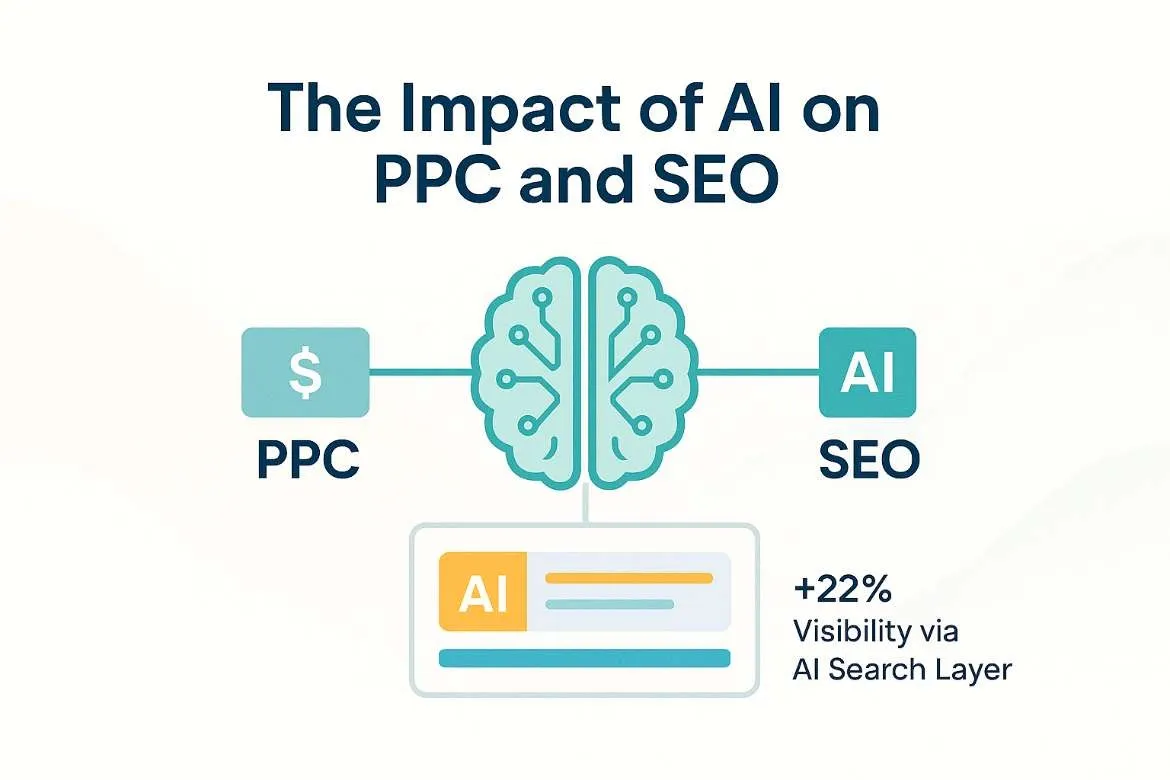
AI now sits alongside SEO and PPC as a third visibility layer. The traditional PPC vs SEO argument no longer fits because user behaviour, SERPs, and platform bidding systems have evolved. The focus is shifting from simply ranking in search engines to being referenced in AI-generated results.
What changes with AI:
- Discoverability and trust now extend into AI systems, not just search engines.
- The economics of PPC vs SEO change as AI emphasises genuine authority and structured content.
- SEO, PPC, and AI should be viewed as interconnected layers, not competing silos.
How to adapt:
- Optimise for AI discoverability with structured content and entity awareness.
- Integrate AI thinking into your SEO and PPC strategies rather than treating AI as separate.
- Keep moving forward through the AI storm: plot a path, adjust your approach, and focus on visibility across all three layers
In practical terms, that means aligning your teams so SEO content is structured and authoritative, PPC is informed by real user intent, and both are designed to be useful enough to be cited or surfaced by AI systems.
Attribution and Measuring Success
Attribution helps you identify which channels contribute to conversions so you can allocate budgets and optimise campaigns more effectively. For SEO, attribution makes performance measurable and accountable by tying efforts to rankings and traffic gains. When you evaluate PPC vs SEO, attribution provides the clarity to defend spend, shift budgets, and scale what works.
What to implement:
- PPC replacement plan
- Some agencies increasingly replace PPC with SEO over time to capture long-term organic growth and better ROI. A PPC replacement plan lets you reallocate budget gradually from paid search to organic investments with measurable milestones.
- Report like a PPC team
- Shift reporting to meaningful metrics—conversion lifts and crawl progress—rather than vanity rankings. This brings SEO into the same performance conversation as paid.
Common attribution mistakes to avoid:
- Misattributing conversions to the wrong channel, leading to poor budget decisions.
- Relying on rankings alone instead of conversion-related metrics that reflect real business impact.
The outcome: a PPC vs SEO programme measured by incremental contributions and conversion lifts, with budgets aligned to the channels (or combinations) that demonstrably move revenue.
Conclusion: Turning PPC vs SEO into One Growth Engine
PPC delivers speed and control; SEO compounds and builds credibility. The strongest programmes integrate the two, stabilise performance during volatility, and use shared data to prioritise high-intent opportunities. Layer in AI-focused structure and entity clarity, unify performance metrics like Core Web Vitals, and measure incrementality through attribution. That is how you turn PPC vs SEO from a debate into a durable growth strategy.
FAQ
Q1. How can I choose between PPC and SEO services for promoting my business with Rankforge AI?
Choose based on your goals and timeline: PPC for immediate traffic and promotions, SEO for long-term, sustainable visibility. Most teams get the best results by combining both—using PPC for quick wins while SEO builds organic momentum.
Q2. What does it cost to implement PPC campaigns compared to SEO strategies using Rankforge AI?
PPC carries immediate, ongoing costs per click and can become expensive on competitive keywords, while SEO is less expensive over the long term but takes longer to deliver returns. Budget for PPC when you need instant visibility, and invest in SEO to reduce acquisition costs over time.
Q3. How long does SEO take to show results compared to PPC?
SEO typically takes weeks to months, often 3–6 months, to show meaningful gains. PPC can drive traffic immediately once your campaigns go live.
Q4. When should I use PPC to support SEO during volatility?
Use PPC to stabilise traffic during SEO penalties or core updates that cause ranking fluctuations. It helps maintain consistent performance while you adjust and improve your organic presence.
Q5. How can PPC data improve my SEO keyword strategy?
Leverage PPC to identify high-converting keywords, then prioritise those topics for SEO content and optimisation. This approach proves the value of ranking organically for terms that already drive conversions.
Q6. What should I measure to judge success across PPC and SEO?
Focus on conversion-related metrics and incremental lifts rather than just rankings or clicks. Use attribution to understand each channel’s contribution, and report on outcomes like conversion lifts and crawl progress to guide budget and strategy.
Ready to elevate your digital strategy? Let Rankforge AI help you create optimised articles that not only rank well on search engines but also engage your audience effectively—visit us at rankforgeai.247-workforce.com to get started!