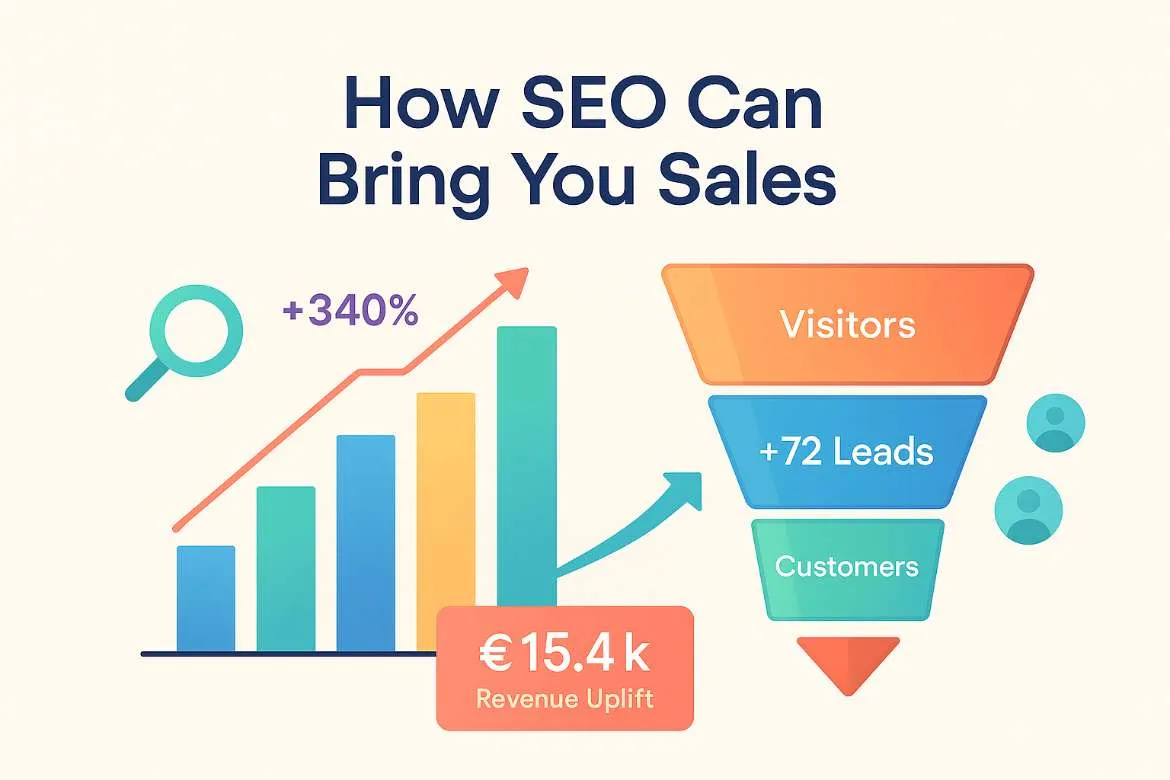
How SEO Can Bring You Sales (Not Just “Traffic”)
You’re not actually seeking: “Does SEO work?”
You’re seeking: “Will SEO bring me sales that justify the spend?”
SEO can 100% bring you sales.
But only when you set it up the right way.
Step 1: Make sure SEO won’t send people to a broken offer
SEO is a traffic engine.
It does not fix a weak offer or a confusing website.
Before you think about rankings, ask yourself:
Can a stranger understand what you do in 5 seconds?
Is it obvious who you help and what problem you solve?
Do you show proof?
Reviews, case studies, logos, numbers, anything real.Is it easy to contact you or buy from you?
If the answer is “not really”, fix this first.
SEO tends to amplify what already works.
If your site already gets some leads and sales, SEO can pour fuel on that.
If your site converts badly, more traffic just means more people leaving.
Step 2: Check if SEO fits your niche
SEO works best when:
People already search for what you sell.
Your niche is not hyper-competitive.
(Or you have the budget and patience to compete.)
Do this quick check:
Type your main service or product into Google.
Example: solar panel installation london or b2b saas onboarding software.Look at the results:
Are you seeing real businesses or just directories?
Do you see obvious competitors?
Are there ads at the top? That’s a sign the keyword makes money.
If you see similar businesses doing well in search, that’s good.
It means SEO already works in your space.
If no one shows up for anything you sell, SEO might not be the main channel.
You can still use it, but don’t treat it as the only growth lever.
Step 3: Decide what “sales from SEO” actually means for you
“More traffic” is useless by itself.
You want revenue, not vanity metrics.
Define success clearly:
How many leads or sales per month do you want from organic search?
What is a lead worth to you?
What is a sale worth to you?
What is your average customer lifetime value?
Example:
You sell a service worth £1,000.
You want 5 new customers a month.
Each customer stays with you 2 years.
That’s £2,000 lifetime value per customer.
If you pay £1,000/month for SEO and it brings 5 customers/month, you pay £200 per customer and make £2,000. That’s a no-brainer.
Without these numbers you can’t judge if SEO is “working”.
Also prepare your tracking:
Install proper analytics (GA4 or similar).
Track:
Calls
Form fills
Demo bookings
Purchases
Try to tag what came from:
Organic search
Paid ads
Social
Direct
You can’t improve what you don’t measure.
Step 4: Choose how you’ll do SEO (agency vs in-house vs freelancer vs DIY)
You have four main options:
1. Do it yourself
Best when:
You’re just starting.
You have more time than money.
You want to learn the basics.
You can:
Improve your pages.
Write helpful content.
Set up basic local SEO and on-page fixes.
Downside: it’s slow, and you will make mistakes.
Upside: you understand exactly what’s happening.
2. Hire an in-house SEO
Best when:
You already make decent revenue.
SEO is going to be a core channel.
You want long-term, compounding results.
Pros:
They live inside your brand.
They can work closely with sales, product, and support.
They care about your results, not billable hours.
Cons:
Salary + tools = real cost.
You must hire well and manage them.
3. Work with a freelancer
Best when:
You want hands-on work.
Your budget is limited.
You want to avoid agency overhead.
A good freelancer can:
Do focused work on your site.
Build links.
Fix technical issues.
Write or guide content.
You just need to vet them well and keep them aligned with your goals.
4. Hire an SEO agency
Best when:
You want a whole team: strategist, content, tech, links.
You don’t have time to coordinate multiple people.
You want experience across many projects.
The price range you mentioned (£500–£1,500/month) is common, but:
At £500, expect limited hours and slower progress.
At £1,500, you should see:
Solid strategy
Real content
Technical improvements
Link building
Reporting tied to leads, not just traffic
The model itself isn’t magic.
Freelancer, agency, or in-house — execution is what brings sales.
Step 5: If you hire an agency, vet them ruthlessly
This is where many businesses get burned. Here’s how you protect yourself.
Ask them:
“What exactly will you do for this budget?”
You want clear deliverables, such as:
Number of pages improved per month
Research and writing of new content
Technical fixes
Number and quality of backlinks
Monthly reporting
Vague answers like “we’ll improve your SEO” are a red flag.
“Can you show recent case studies with ROI?”
Look for:
Real businesses, not anonymous logos.
Before and after numbers:
Organic traffic
Leads
Revenue
Results from the last 6–12 months.
Traffic graphs alone are not enough.
Ask: “What did this mean in actual leads or sales?”
“Which keywords are you targeting and why?”
Watch out for:
Long lists of keywords that sound nice but have no search volume.
Keywords with traffic but no buying intent.
You want a mix of:
High-intent terms:
“emergency plumber bristol”, “b2b onboarding software pricing”Mid-funnel topics:
“how to choose x”, “best x for y”Brand terms:
“[your brand] reviews”, “[your brand] pricing”
“How do you pick link opportunities?”
Good answers talk about:
Relevant websites.
Real traffic.
Clean backlink profiles.
Editorial links from articles, not spammy directories.
Bad signs:
Huge promises like “500 backlinks per month”.
Lists of random sites with no relevance.
Private blog networks (PBNs) with thin content.
“What does success look like in 3, 6, and 12 months?”
You want honest expectations:
First 1–3 months:
Audit
Fixes
Content planning
Early improvements on easy wins
Months 3–6:
Rankings start climbing
More organic leads
Months 6–12:
Stable rankings on money terms
Predictable leads or sales
If they promise page-one rankings for big keywords in 30 days, run.
Watch for these red flags
Long contracts (12 months) with no break clause.
Strategy = “publish blogs every week” and nothing else.
No technical work, no UX, no focus on your main service pages.
Heavy use of generic AI content with zero editing.
Reports full of “keywords ranked” but no talk about leads or revenue.
Step 6: Focus on SEO work that actually drives sales
SEO that brings sales has a few key pieces.
1. Get your “money pages” right
These are:
Service pages
Product pages
Category pages
High-intent landing pages
Each one should:
Target a clear keyword and search intent.
Explain the offer simply.
Show proof and trust.
Make it easy to act:
“Call us”
“Book a demo”
“Add to cart”
SEO without strong money pages is like sending traffic to a half-built store.
2. Use keywords that real buyers search
Make sure your keywords:
Have real search volume.
Match what people actually want to do:
Learn
Compare
Buy
Examples of buyer intent:
“best [product] for [use case]”
“[service] near me”
“[software] pricing”
“[competitor] alternatives”
Avoid wasting effort on:
Keywords no one searches.
Broad topics that attract noise, not buyers.
3. Build authority with smart content
You don’t need 200 random blog posts.
You need useful, focused content.
Think in themes:
If you offer EV charging services:
“How to choose the right EV charger for your home”
“EV charger installation cost breakdown”
“Commercial EV charging: what you need to know”
If you sell B2B SaaS:
“How to onboard new users without support overload”
“Onboarding metrics that actually matter”
“Onboarding checklist for [your industry] teams”
Each piece should:
Answer one clear question.
Use simple language.
Point to your product or service when relevant.
4. Nail your local SEO if you’re a local business
If you serve a local area, this can be huge.
Focus on:
Your Google Business Profile:
Correct name, address, and phone.
Clear categories.
Photos, description, and services.
Reviews:
Ask happy customers to leave a review.
Reply to every review.
Local pages:
“[service] in [city]”
Case studies from local clients.
The right local setup can send you a steady stream of calls and visits.
5. Get ready for AI search and LLM “answer boxes”
Search is shifting.
People now use AI tools and AI answers inside search engines.
To benefit from this, structure your content so machines can quote you:
Use clear headings that match questions.
Answer questions in short, direct paragraphs.
Include definitions, steps, and bullet points.
Be specific and factual.
This helps you:
Show up in featured snippets.
Get cited in AI overviews.
Attract very high-intent visitors who are ready to buy.
Step 7: Align SEO with your sales process
SEO can absolutely flood you with leads.
That’s not always a blessing.
If you get:
50 leads a month
But no one follows up
Or your team is overwhelmed
You will feel like SEO “doesn’t work”.
Make sure:
You have enough sales capacity.
You have a clear follow-up process.
You respond fast to inbound leads.
You qualify leads and track outcomes.
SEO brings the opportunities.
Your sales system turns them into revenue.
Step 8: Understand the timeline and stay patient
Most real-world stories look like this:
Month 1–2:
You pay. You see audits, fixes, maybe some content. No big change.Month 3–4:
Rankings start to move. Some more leads. Still inconsistent.Month 5–7:
Money keywords start hitting page one. You feel the lift.Month 8–12+:
SEO becomes a main growth channel.
This is also why many businesses quit too early.
They stop right before the compounding kicks in.
If you want “sales tomorrow”, use paid ads.
If you want sales stronger six months from now than today, invest in SEO.
Quick recap: how SEO can bring you sales
You get sales from SEO when you:
Fix your offer and website so they convert.
Confirm people actually search for what you sell.
Decide what “success” means in leads, sales, and revenue.
Pick the right model: DIY, freelancer, in-house, or agency.
Vet any SEO partner with hard questions and a focus on ROI.
Focus work on:
Money pages
Real keywords with volume and intent
Useful content
Local SEO (if relevant)
Clear structure for AI and LLM-driven search
Align SEO with a solid sales process and give it time.
Do that, and SEO stops being a mysterious cost.
It becomes a predictable system that brings you sales month after month.