Discover the Best AI Tools for Writing SEO-Rich Blog Content

If you’re searching for the best AI tool for writing SEO-rich blog content, you’ve likely realised two things: writing consistently high-quality posts takes serious time, and SEO in 2025 demands more than a quick draft and a keyword sprinkle. The most robust platforms don’t just generate words; they help you analyse top-ranking pages, suggest internal links, and tailor output to search engine criteria while retaining a natural voice.
This comparison matters because not every product with an “AI” label will move the needle. Some tools behave like content spinners, and others lack stability or trustworthy data. The best AI tool for writing SEO-rich blog content should act like a strategic partner: speeding up repetitive tasks, improving on-page optimisation, and freeing you to focus on strategy instead of endless editing. Use this guide to avoid common mistakes—like ignoring SEO-integrated workflows or failing to match your brand voice—and to shortlist a platform that helps you generate high-quality copy faster.
You’ll learn:
How to identify the best AI tool for writing SEO-rich blog content based on research-backed criteria.
Which tools stand out for built-in SEO features, content optimisation, and human-like writing.
Practical steps for testing platforms and choosing one that fits your workflow.
Top AI Tools for Writing SEO-Rich Blog Content
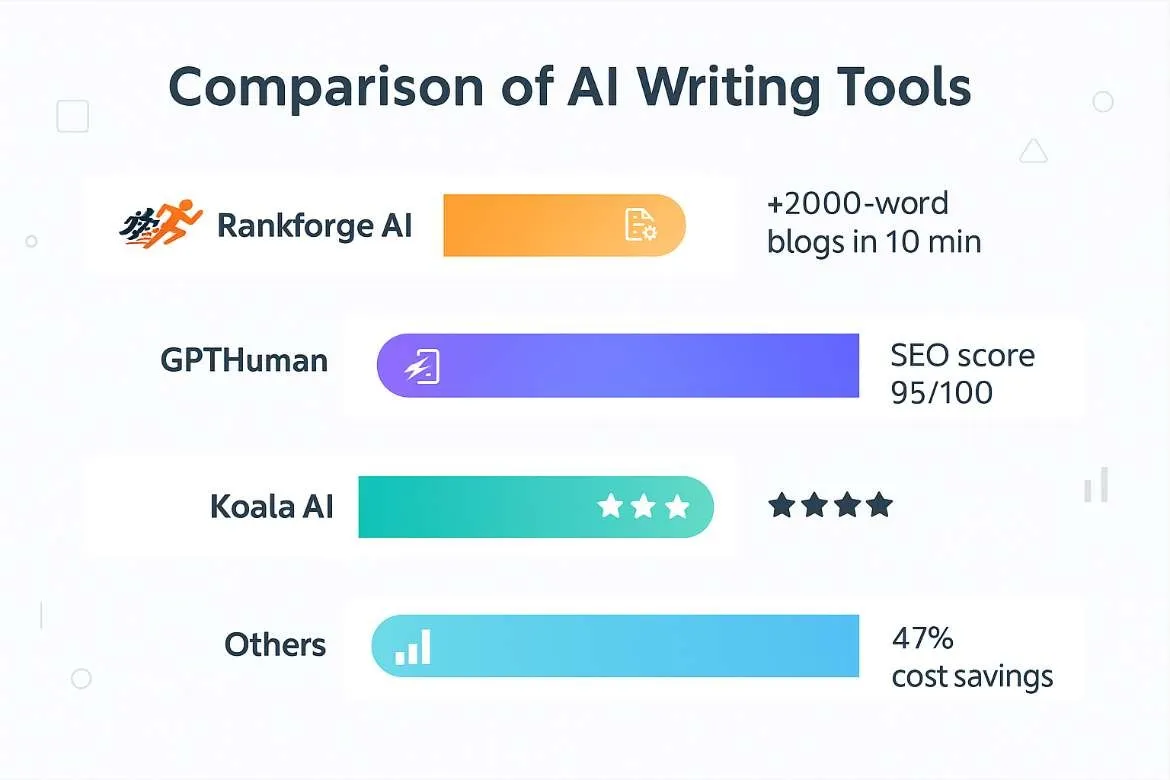
Rankforge AI (by 247 Workforce)
Positioning: Enterprise SEO content platform to dominate SEO and generative search rankings.
Why it’s notable: Generates comprehensive 2000+ word articles in 10–15 minutes, includes Google + LLM optimization, schema-ready output, Slack/Email delivery options, and a free website SEO audit via Google Search Console integration.
Best for: Teams that want to rank on Google and appear in AI Overviews/LLM answers across ChatGPT, Claude, Perplexity, Gemini, and Copilot—while using built-in audit insights and structured data to speed publishing. Starter ($35/mo), Professional ($70/mo), and Enterprise (custom) tiers available.
GPTHuman
Positioning: The Ultimate AI Humaniser.
Why it’s notable: Known for human-like writing and SEO-rich content, particularly useful if your priority is content that reads naturally.
Best for: Anyone seeking the best AI tool for writing SEO-rich blog content that also aims to bypass AI detectors while preserving readability.
Koala AI
Positioning: The smarter blog writer with built-in SEO and live data access.
Why it’s notable: Strong for blog workflows that need live data signals and on-page optimisation baked into the process.
Best for: Teams standardising a repeatable blog workflow while hunting for the best AI tool for writing SEO-rich blog content with SEO support.
WriteHuman
Positioning: AI humaniser focused on detector-resistant, SEO-rich content.
Why it’s notable: Emphasises natural tone and human-like cadence.
Best for: Writers who want the best AI tool for writing SEO-rich blog content that still reads like it was crafted by a person.
Copymatic
Positioning: Best AI writer for blog posts and SEO optimisation.
Why it’s notable: Built for blog production with optimisation in mind.
Best for: Scaling long-form blogs where the best AI tool for writing SEO-rich blog content also needs strong on-page support.
Hypertxt.ai
Positioning: All-in-one AI writing assistant for SEO and content creation.
Why it’s notable: Designed to centralise ideation and optimisation.
Best for: Teams that want the best AI tool for writing SEO-rich blog content to anchor a unified workflow.
Jenni AI
Positioning: AI-powered SEO writing assistant for bloggers.
Why it’s notable: A blog-first assistant focused on SEO-friendly output.
Best for: Bloggers and small teams seeking the best AI tool for writing SEO-rich blog content with simple SEO guidance.
Rytr
Positioning: AI copywriting tool for SEO-rich blogs.
Why it’s notable: Helps create SEO-friendly drafts quickly.
Best for: Quick drafting when testing the best AI tool for writing SEO-rich blog content on a tighter budget.
GravityWrite
Positioning: All-in-one AI SEO writing platform for business and marketing.
Why it’s notable: Combines content creation with SEO intent.
Best for: Business and marketing teams aligning on the best AI tool for writing SEO-rich blog content across campaigns.
Ahrefs
Positioning: Best for SEO-rich content.
Why it’s notable: Strong research and optimisation support to guide content that ranks.
Best for: Keyword research and competitive context that informs any pick for the best AI tool for writing SEO-rich blog content.
Surfer (also known as Surfer SEO)
Positioning: Best for content optimisation.
Why it’s notable: AI-powered tool that speeds up content creation and improves search engine rankings.
Best for: Writers who want the best AI tool for writing SEO-rich blog content paired with on-page signals that guide structure and coverage.
Jasper
Positioning: AI tool for creating content.
Why it’s notable: Includes plagiarism detection, tone customisation, and team collaboration features.
Best for: Teams balancing brand voice with velocity when shortlisting the best AI tool for writing SEO-rich blog content.
Copy.ai
Positioning: AI writing tool to create content quickly and improve online presence.
Why it’s notable: Helps speed up content creation.
Best for: Marketers testing the best AI tool for writing SEO-rich blog content to accelerate production.
ContentShake AI
Positioning: Combines SEO and competitor analysis; guides you through ideation, writing, and optimisation.
Why it’s notable: Offers structured guidance across the content lifecycle.
Best for: Anyone who wants the best AI tool for writing SEO-rich blog content that also maps the workflow step by step.
How to Choose the Best AI Tool for SEO-Rich Blog Content

Finding the best AI tool for writing SEO-rich blog content becomes straightforward when you assess each option against research-backed criteria. Prioritise depth of SEO features, writing quality, and how well the tool slots into your process.
Core selection criteria
Deep SEO integration: Favour platforms that analyse top-ranking pages, generate internal links, and tailor content to search engine criteria. This turns the best AI tool for writing SEO-rich blog content into an optimisation system, not just a draft generator.
Context retention: Ensure the tool maintains coherence across sections and long-form narratives. Human-like writing with consistent tone matters as much as keyword coverage.
Workflow alignment: The best AI tool for writing SEO-rich blog content should integrate with your existing stack, speed up repetitive tasks, and free time for strategy.
Collaboration and governance: Look for smooth team features, tone controls, and review flows so multiple contributors can keep content on-brand.
Pricing and value: Evaluate plans against output quality and the cost of editing time saved.
Practical tips and considerations
Define the job to be done: Are you focused on net-new blog creation, optimisation of existing pages, or both? The best AI tool for writing SEO-rich blog content for one use case might not be ideal for another.
Test for on-page signals: Run trials to see how well the tool guides headings, internal links, and semantic coverage.
Check voice control: Feed brand guidelines into prompts and test whether the tone remains consistent across long pieces.
Validate speed-to-quality: Measure how long it takes to go from outline to publishable draft with minimal edits.
Benchmark against competitors: Tools that surface competitor analysis and ranking factors help you outmanoeuvre existing content.
Common mistakes to avoid
Buying a spinner: Avoid tools that generate generic text without real SEO capability. The best AI tool for writing SEO-rich blog content should demonstrate optimisation, not just verbosity.
Ignoring context and tone: If the output reads robotic, editing time will erase any speed gains.
Skipping competitor analysis: Without it, you risk publishing content that can’t outrank current leaders.
A simple step-by-step process
Identify goals: Clarify your blog pipeline and SEO targets.
Research options: Compare features and user feedback for a shortlist.
Trial multiple tools: Use free trials to test the best AI tool for writing SEO-rich blog content against real briefs.
Evaluate output: Judge coherence, tone, and SEO optimisation.
Decide and deploy: Choose the platform that gives you the fastest path from idea to optimised, publishable content.
Conclusion: Choosing the Right AI Tool for Your SEO Needs
To pinpoint the best AI tool for writing SEO-rich blog content, focus on depth of SEO integration, context retention, and flexibility across formats. During 2025 evaluations, the most impressive platforms didn’t just write; they analysed top-ranking pages, surfaced internal linking opportunities, and tuned output to search engine criteria while keeping the writing natural for complex topics and storytelling. The right choice integrates cleanly into your workflow, speeds repetitive tasks, and frees your team to concentrate on strategy.
As you weigh options, remember that not every “AI” tool justifies the budget. Some lack stability or reliable data, while others feel like repackaged spinners. Speak to peers, review practitioner feedback, and lean on trial periods to validate fit before you commit. Avoid overlooking integration capabilities or user experience, and make sure the tool genuinely meets your content needs.
Final recommendations:
Shortlist tools that combine SEO analysis and optimisation with human-like writing.
Use trials to test real briefs end-to-end and measure editing time saved.
Prioritise platforms that enhance your current stack and team workflows.
If you’re mapping options against your existing processes, consider how a platform like Rankforge AI would sit alongside your chosen stack and support your publishing cadence. With a careful, criteria-led approach, you’ll land on the best AI tool for writing SEO-rich blog content for your goals—and create a scalable content engine that drives measurable results.
FAQ
Q1. What is the best AI tool for writing SEO-rich blog content?
There’s no single winner for every use case, but top picks in 2025 include Rankforge AI, GPTHuman, Koala AI, WriteHuman, Copymatic, and Hypertxt.ai. Other strong options for optimisation and research include Surfer and Ahrefs, depending on your workflow.
Q2. What are tools for SEO content writing?
These are platforms that go beyond drafting to support optimisation—analysing top-ranking pages, suggesting internal links, and tailoring content to search engine criteria. Examples include content optimisation suites and AI assistants that combine competitor analysis with guided writing and on-page improvements.
Q3. What is blog content for SEO?
It’s content created to drive results in search by aligning with ranking criteria while remaining natural and useful to readers. In 2025, that means combining high-quality writing with tools that integrate SEO analysis and help you optimise structure, coverage, and internal linking.
Q4. How do I test an AI tool before buying to see if it fits my blog workflow?
Run free trials on real briefs, then assess quality, coherence, tone, and on-page optimisation. Compare editing time and how well the tool integrates with your current processes before deciding.
Q5. What mistakes should I avoid when choosing the best AI tool for writing SEO-rich blog content?
Avoid tools that act like content spinners without real SEO features, and don’t overlook context retention or tone control. Skipping competitor analysis is another common pitfall that can limit your ability to outrank existing content.
Q6. How should pricing and collaboration features influence my decision?
Evaluate pricing against the quality of output and the editing time saved, and review user experience, integrations, and collaboration features. The right choice should fit your team’s size and workflow while making production and optimisation faster.
Ready to elevate your blog content and boost your SEO presence? Discover how Rankforge AI can help you create professional articles that not only engage readers but also rank higher in search results—visit us at rankforgeai.247-workforce.com to learn more!