Maximise Your Efficiency: Discover How AI Writing Tools Transform Your Business Communication
Artificial intelligence has moved from science fiction to everyday business reality, and nowhere is that clearer than in the rise of ai writing tools. By blending natural language processing with vast language models, these platforms now draft copy that sounds uncannily human—often in seconds. For time-pressed business owners juggling SEO, marketing and customer engagement, that capability can feel like rocket fuel. Yet, like any technology, success depends on knowing where it shines, where it stumbles and how to wield it strategically.
Understanding AI Writing Tools
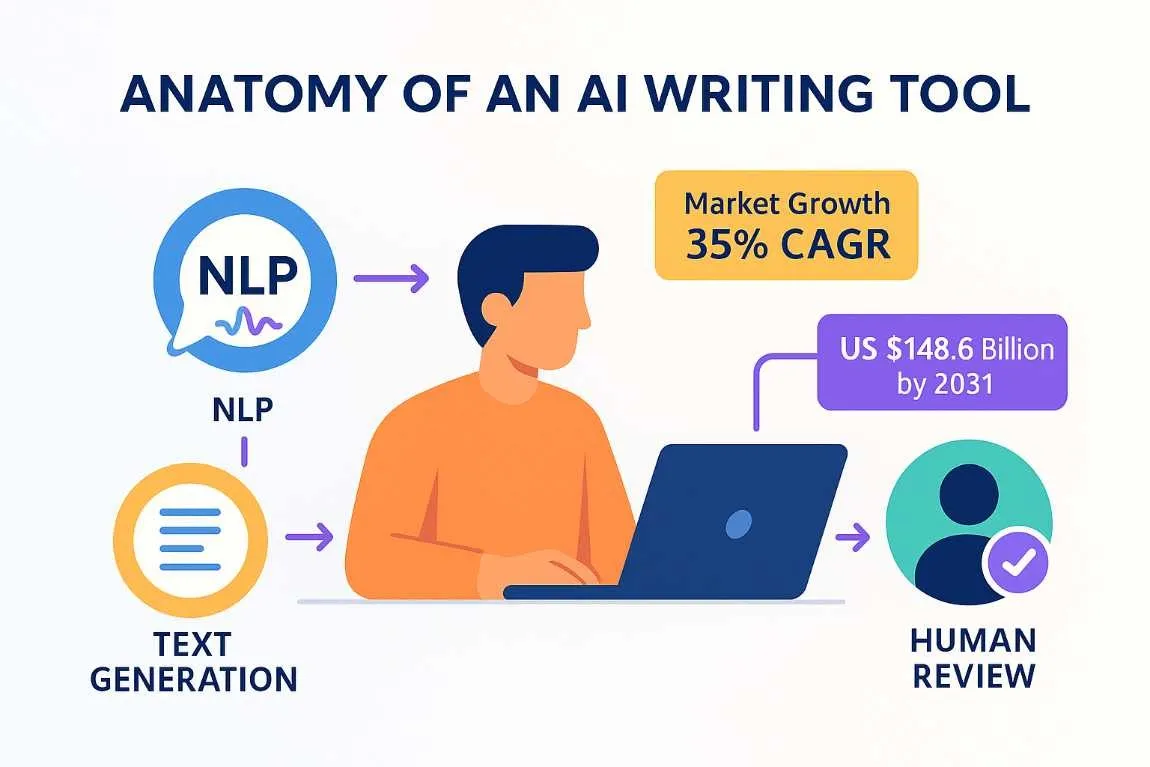
At their core, ai writing tools combine machine-learning models—most commonly Generative Pre-trained Transformers—with user prompts. You type a topic, product description or even an outline and the system predicts the next words, generating text that is contextually relevant, grammatically correct and aligned with your chosen tone. Because these models have been trained on billions of sentences, they recognise patterns, idioms and industry-specific vocabulary, allowing them to write in multiple styles, from formal reports to chatty blog posts.
Demand is soaring. The global market for ai writing and text generation software was valued at about US $7.9 billion in 2024 and is forecast to rocket to roughly US $148.6 billion by 2031, a compound annual growth rate of 35%. That jump mirrors the relentless appetite for high-quality digital content across e-commerce, publishing, customer service and, of course, SEO.
While the technology impresses, one frequent misstep is relying on it blindly. The smartest approach pairs machine speed with human judgement—treat the tool as a tireless assistant, not an autonomous author.
Where AI Writing Tools Add Real Value
Speedy content generation
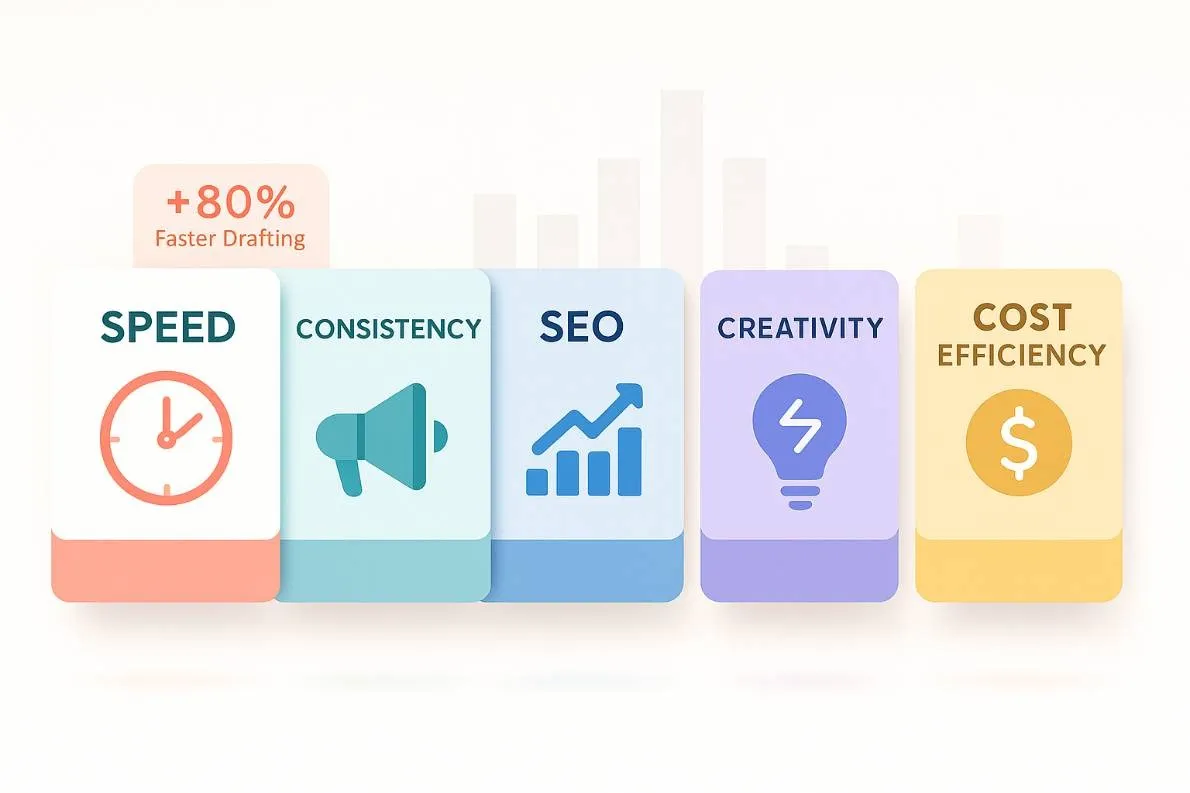
Whether you need a 2,000-word pillar article or 50 product blurbs, ai writing tools slash drafting time. That lets your team focus on strategy, outreach and higher-value tasks.Consistency across channels
Maintaining a unified voice in emails, social posts and website copy is tough when several people contribute. An ai assistant can apply the same tone and brand language template every time.SEO optimisation at scale
Many platforms weave in keyword placement, meta descriptions and suggested headings, ensuring each piece ticks core on-page SEO boxes. That lets you turn out search-friendly articles without poring over every density calculation.Overcoming writer’s block
Staring at a blank screen wastes precious hours. By prompting an ai engine you receive an instant first draft, sparking ideas and momentum.Cost efficiency
Compared with hiring additional copywriters for repetitive or data-heavy content (think category pages or FAQs), ai writing tools often deliver similar volume at a fraction of the cost.
Such advantages explain why e-commerce and digital marketing teams, which require mountains of timely copy, are among the earliest and most enthusiastic adopters.
Key Features That Matter
Not every platform is identical. When comparing options, weigh these essential features:
Long-form generation
Top-tier systems can sustain logic over 1,000+ words, making them suitable for ultimate guides, white papers or case studies.Built-in SEO suggestions
Some packages analyse search intent, propose semantic keywords and even score readability, all inside the editor.Template libraries
From AIDA sales letters to press releases, pre-built templates accelerate drafting while avoiding format mistakes.Audience targeting
Advanced tools let you specify demographic traits so copy resonates with a distinct customer segment.Rewrite and paraphrase engines
Need to refresh dated blog posts without starting from scratch? A high-quality paraphraser turns existing material into something brand-new while keeping the core message.User-friendly interface
An intuitive dashboard, drag-and-drop headings and real-time previews mean your team adopts the software quickly with minimal training.
For example, Jasper’s long-form assistant and ChatGPT’s conversational mode showcase how far functionality has come. Emerging platforms such as Rankforge Ai add collaborative workflows, enabling marketing managers to assign and track articles in one place.
The Limitations You Must Manage
Despite the hype, ai writing tools are not a plug-and-play replacement for human expertise. Here are the most common pitfalls:
Hallucinations and factual errors
The model predicts plausible sentences, not guaranteed truths. Always fact-check statistics, quotes and technical claims.Generic voice
If you feed a vague prompt, you often receive bland, robotic prose. Without distinctive brand guidelines, your content can feel interchangeable with competitors.SEO false confidence
Some users assume the tool’s suggested keywords are enough to rank. In reality, you still need backlink strategies, site speed optimisation and user engagement.Skill atrophy
Delegating every sentence to a robot can erode in-house writing ability, making it harder to craft nuanced thought-leadership pieces later.Unrealistic expectations
Promoters sometimes frame ai writing tools as a “set and forget” silver bullet. In practice, you must review, edit and polish—the technology accelerates the process; it doesn’t eliminate it.
Handle these challenges by positioning AI as co-writer, not ghostwriter. Insist on a human editorial layer that checks tone, accuracy and brand fit before pressing publish.
Making AI-Generated Content Sound Human

A surprisingly small tweak—your prompt—often determines whether output feels lively or lifeless. Use the following workflow to maximise human appeal:
Clarify the aim
State the content type (e.g., “800-word blog post on summer footwear trends”) plus the desired angle (“expert yet playful”).Supply context
Mention target audience pain points, brand values and any call-to-action. The richer the brief, the better the narrative.Request structure
Ask for headings, bullet points or numbered lists to improve readability.Iterate
If the first draft misfires, refine the prompt. Simple phrases like “make it less formal” or “include a real-world example” change the tone instantly.Edit with human intuition
After generation, scan for logical flow, brand voice alignment and topical accuracy. Tools such as Grammarly or Hemingway can flag awkward phrasing, while your own judgement makes the prose truly shine.
Following this process blends machine efficiency with your expertise, producing content that both search engines and customers trust.
Case Study: Turning a Product Launch Around
Picture this scenario: you’re unveiling a new eco-friendly phone case line. The marketing calendar demands a landing page, 15 ad variants and a series of email teasers—by Friday. Historically that workload would overwhelm a small team. With ai writing tools:
• Tuesday morning: You drop the product specs and target persona into the long-form generator, receiving a draft landing page in under five minutes.
• Tuesday afternoon: Using the template library, you create AIDA and PAS ad copy variations, each tailored to a different platform.
• Wednesday: You feed the landing page draft back into the paraphrase module to craft three email sequences, saving another few hours.
• Thursday: A human editor polishes brand voice, inserts verified statistics on plastic waste and finalises layout.
By Friday, you launch on schedule—without late-night panic or hiring freelancers at premium rates.
Future Trends You Should Watch
Rapid innovation means today’s cutting-edge feature is tomorrow’s baseline. Here are the developments likely to shape your content operation:
Greater contextual memory
Next-generation models will remember brand guidelines across sessions, reducing repetitive prompts.Multimodal output
Instead of simply text, ai writing tools will pair copy with automatically generated visuals, ideal for social campaigns.Deeper analytics integration
Expect real-time feedback on predicted engagement and conversion likelihood, letting you adjust wording before publication.Regulatory oversight
As governments debate disclosures for automated content, transparency features—think AI-generated labels—may move from optional to mandatory.Human-AI collaboration platforms
Tools like Rankforge Ai already incorporate workflow approval chains. Future suites will likely merge project management, optimisation and performance analytics into a single dashboard.
Keeping your team nimble—upskilling writers in prompt engineering and fostering a culture of experimentation—ensures you benefit from these advances rather than chase them.
Practical Implementation Checklist
Define your content bottlenecks. Is it blog volume, product descriptions or outreach emails?
Trial two or three ai writing tools, focusing on interface clarity and SEO functions.
Draft comprehensive prompts, embedding brand voice guidelines and target keywords.
Generate, then review every piece for accuracy and emotional resonance.
Track results in analytics: dwell time, bounce rate, conversions. Let data guide future prompts.
Rotate tasks: ensure human writers continue honing skills, preventing over-reliance on automation.
Sticking to this plan transforms AI from shiny gadget into a dependable asset that compounds over time.
Ready to supercharge your content creation with AI writing tools?
Discover how Rankforge AI can help you craft articles that not only engage your audience but also rank higher in search results. Visit us at rankforgeai.247-workforce.com to learn more!
Frequently Asked Questions
Q1. What are AI tools?
AI tools are software applications that use artificial intelligence techniques—such as machine learning and natural language processing—to perform tasks normally requiring human intelligence. Ai writing tools specifically focus on generating or improving written content.
Q2. How to use ai writing tools effectively?
Start with a clear prompt outlining audience, purpose and desired tone. Generate the draft, review it for factual accuracy, adjust the prompt if necessary and edit the final text to align with your brand voice before publishing.
Q3. What is ai writing tools free?
Many providers offer limited free tiers allowing a set number of words per month. These plans are useful for testing features but often lack advanced SEO functions, templates and higher word limits available in paid versions.
Q4. How can I integrate AI writing into my existing SEO workflow?
Map out your content calendar, create detailed keyword-driven prompts, use the AI to produce first drafts, then run each piece through your standard on-page optimisation checklist before scheduling it in your CMS.
Q5. Will using AI content hurt my search rankings compared with human-written articles?
Not if you apply human oversight. Search engines value relevance, originality and user engagement. By fact-checking, adding unique insights and maintaining readability, AI-assisted articles can rank as well—or better—than purely manual content.
Paid tiers usually unlock higher monthly word counts, long-form generation, dedicated SEO modules, priority support and team collaboration features. The additional efficiency and optimisation options often justify the subscription cost once your content demands scale.